

Many homeowners ask whether air purifiers help with radon when they first learn about this hidden indoor air risk. The simple answer is no.
Air purifiers can improve indoor air quality by removing dust, pollen, and smoke, but they are not designed to remove radon gas from a home. The only reliable way to lower radon levels is through proper radon testing and a professionally installed mitigation system.
Understanding how radon enters a home and how it spreads indoors can help homeowners choose the right solution to better protect their home and their health.
What Is Radon and Why Is It a Concern in Pennsylvania Homes?
Radon is a colorless, odorless radioactive gas that forms naturally in the soil. It comes from the breakdown of uranium found in rocks and dirt.
Because it is a gas, radon can move through the ground and enter homes through small openings in the foundation. These openings may include:
- Cracks in basement floors
- Gaps around pipes or sump pumps
- Construction joints in concrete
- Crawl space floors or exposed soil
Once radon enters a home, it can become trapped indoors. Over time, this gas can build up to levels that may affect health.
Radon is considered the second leading cause of lung cancer in the United States, according to the Environmental Protection Agency (EPA). It is the leading cause among people who have never smoked.
Pennsylvania has some of the highest radon levels in the country. Many homes across Central Pennsylvania test above the EPA action level of 4.0 pCi/L. Because radon levels cannot be seen or smelled, testing is the only way to know if a home has a problem.
Why Homeowners Ask if Air Purifiers Help With Radon
Many homeowners searching for ways to improve indoor air quality wonder if an air purifier can solve a radon problem. It is a common question people ask online, especially after learning that radon is an invisible gas that affects the air inside a home.
Because of this, it helps to answer the question clearly. Understanding whether air purifiers help with radon can clear up a common misconception and help homeowners focus on solutions that actually work.
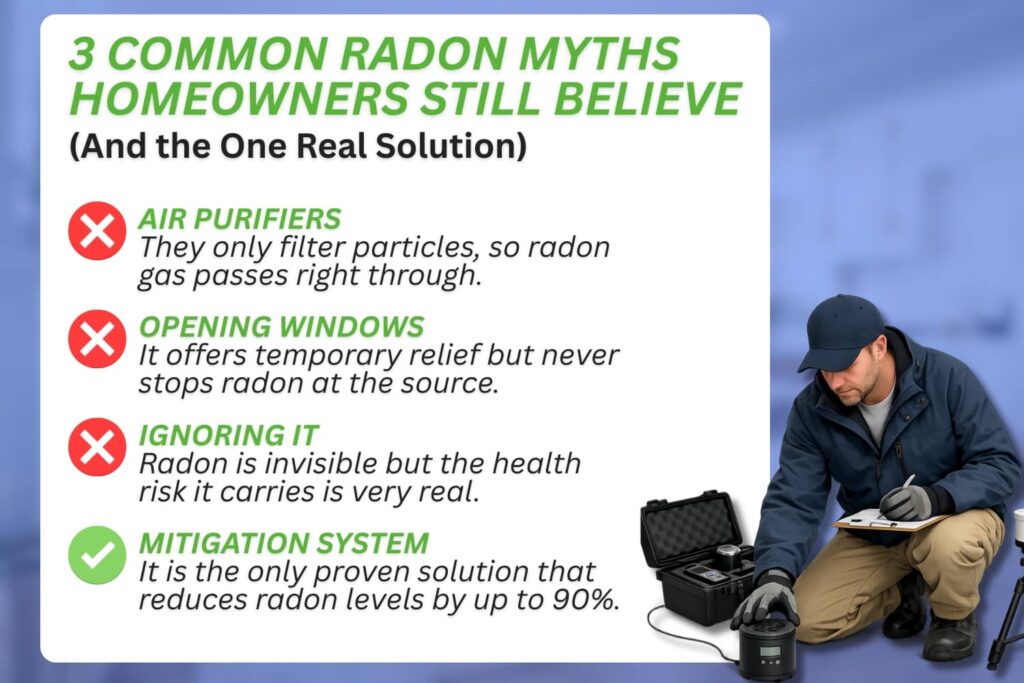
In this guide, we explain why air purifiers are not designed to remove radon gas, how radon behaves inside homes, and what homeowners in Central Pennsylvania can do to properly test and reduce radon levels. The goal is to help you make informed decisions about protecting your home and family.
Do Air Purifiers Help With Radon Gas?
Most air purifiers do not remove radon gas.
Air purifiers are designed to capture particles in the air. These particles may include:
- Dust
- Pollen
- Pet dander
- Mold spores
- Smoke particles
Many air purifiers use HEPA filters, which are very effective at trapping tiny airborne particles. However, radon is not a particle. It is a gas, which means it passes through most filters without being captured.
Some air purifiers also include activated carbon filters. These filters can absorb certain odors and chemicals. Even so, they are not designed to remove radon gas from the air in a meaningful way.
In some cases, air purifiers may capture small radioactive particles that form after radon begins to break down. These particles are called radon decay products. But removing these particles does not stop radon gas from continuing to enter the home.
For this reason, air purifiers should not be relied on to solve a radon problem.
Why Air Purifiers Cannot Solve a Radon Problem
To understand why air purifiers do not work for radon, it helps to look at how they compare to a proper radon mitigation system.
| Feature | Air Purifier | Radon Mitigation System |
|---|---|---|
| What it targets | Dust, pollen, smoke, and airborne particles | Radon gas coming from the soil |
| How it works | Filters indoor air using HEPA or carbon filters | Pulls radon gas from beneath the home and vents it outside |
| Ability to remove radon gas | No | Yes |
| Scope of coverage | Small indoor air area | Entire foundation and living space |
| Long term radon solution | No | Yes |
Radon gas moves continuously from the soil into a home through small openings in the foundation. Because of this, filtering indoor air does not stop the gas from entering.
Radon problems require source control, which means removing the gas before it reaches the living space. That is why mitigation systems are considered the proven solution for reducing radon levels in homes.
The Most Effective Way to Reduce Radon in a Home
The proven solution for high radon levels is a radon mitigation system.
A radon mitigation system works by safely venting radon gas from beneath the home before it can enter indoor air.
The most common method is called sub-slab depressurization. This system usually includes:
- A pipe inserted through the basement floor or foundation
- A radon mitigation fan that pulls gas from beneath the home
- A vent pipe that carries the radon safely above the roofline
This system creates lower pressure beneath the foundation, so radon gas is pulled outside instead of into the home.
When installed correctly, radon mitigation systems can reduce radon levels by up to 99 percent or more.
Professional radon contractors design these systems based on the structure of the home, including the foundation type, soil conditions, and airflow patterns.
Signs Your Home May Need Radon Testing
Radon can affect both old and new homes. Even homes next door to each other can have very different radon levels.
Testing is recommended for most homes, but certain situations make testing even more important.
You should consider radon testing if:
- Your home has a basement or crawl space
- You are buying or selling a home
- Your neighbors have reported high radon levels
- Your home has never been tested before
- You completed renovations that changed airflow or foundation openings
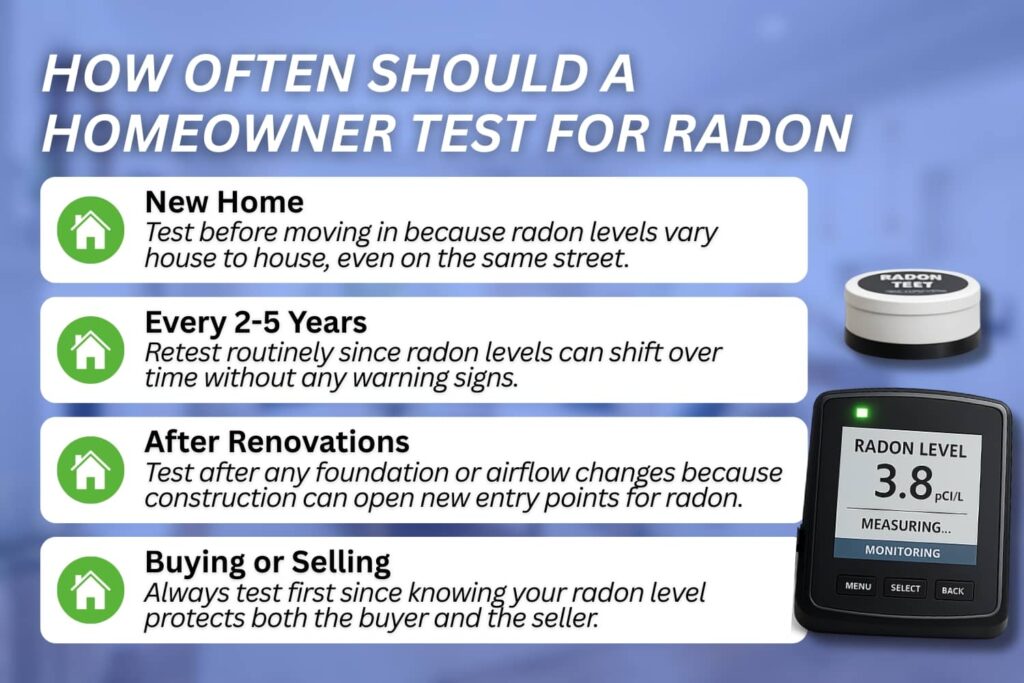
Health organizations recommend testing every two to five years, or after major structural changes.
Because radon cannot be detected by smell or sight, testing is the only way to know the level inside your home.
Why Professional Radon Testing Matters
Homeowners can purchase short-term radon test kits at hardware stores. These kits can provide a basic reading of radon levels.
However, professional radon testing offers several advantages.
Certified professionals often use continuous radon monitors, which track radon levels over time. These devices provide more detailed results and help detect changes in radon levels throughout the day.
Professional testing can also identify factors that affect radon levels, such as:
- Foundation design
- Air pressure inside the home
- Ventilation patterns
This information helps determine whether a mitigation system is needed and what type of system will work best.
For homeowners in Central Pennsylvania, professional testing provides a clearer picture of the radon risk in their home.
Related Questions
Can HEPA filters remove radon gas?
No. HEPA filters are designed to capture particles such as dust and pollen. Radon is a gas, so it passes through HEPA filters without being removed.
Do air purifiers remove radon decay particles?
Some air purifiers with carbon or HEPA filters may capture a small number of radon decay particles. However, this does not stop radon gas from entering the home.
How common is radon in Pennsylvania homes?
Pennsylvania is considered a high radon area. Many homes across the state test above the EPA action level. Testing is recommended for most homes in the region.
Conclusion
Radon is a serious issue in many Pennsylvania homes, but the good news is that it can be addressed with the right approach.
Air purifiers may help improve general air quality, but they are not a solution for radon gas. The most effective way to protect your home is to test for radon and install a mitigation system if levels are elevated.
Enviroquest Home Integration & Radon Mitigation provides radon testing and mitigation services for homeowners in the Harrisburg area. Their team can help determine your radon levels and recommend the right solution if mitigation is needed.