
If you have ever opened your attic hatch and noticed moisture on the wood, frost on the nail tips, or a faint musty smell drifting down, you are not imagining things. Attic condensation is one of the most common moisture problems found during a professional home inspection and one of the most misunderstood.
Most homeowners assume the culprit is a roof leak. In many cases, it is not. The real source is often the air inside your home, and understanding that difference can save you from unnecessary repairs and help you catch a serious problem before it gets worse.
If your home is in the Harrisburg area or anywhere across Central Pennsylvania, the late winter and early spring months are when attic condensation problems tend to surface. Here is what you need to know.
What Is Attic Condensation and Why Does It Happen?
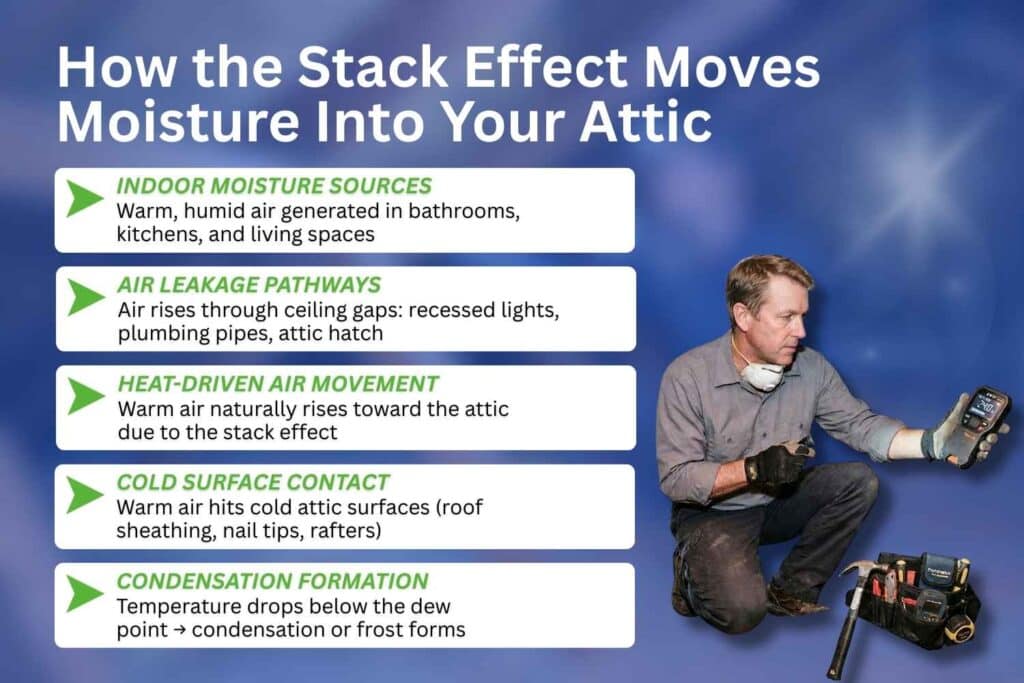
Warm air holds moisture. Cold surfaces do not. When warm, humid air from your living spaces rises through gaps and openings into a cold attic, it hits surfaces like roof sheathing, rafters, and nail tips that are well below the temperature needed to keep that moisture airborne.
The result is condensation: water droplets, wet wood, or frost, depending on how cold it gets.
This process happens through a force called the stack effect. Warm air naturally rises through every unsealed gap in your ceiling, around light fixtures, plumbing pipes, attic hatches, and wall top plates.
It does not need much of an opening to move a significant amount of moisture into your attic over the course of a winter.
The same indoor humidity that causes condensation on your windows is often the same moisture finding its way into your attic. The difference is that window condensation is easy to see and wipe away. Attic condensation can build up silently for months before any visible damage appears.
The 5 Most Common Causes of Attic Condensation
Attic condensation rarely has a single cause. In most inspections, it is the result of two or three of these problems working together.
1. Air Leaks from the Living Space
This is the number one driver of attic moisture. Warm air escapes through openings around recessed light fixtures, plumbing and electrical penetrations, unsealed attic hatches, open wall top plates, and HVAC duct chases. Every gap is a pathway for moisture-laden air to reach cold attic surfaces.
2. Exhaust Fans Venting into the Attic
Bathroom and kitchen exhaust fans are designed to remove moisture from your home. When they terminate inside the attic instead of outside, they dump that moisture directly onto your roof sheathing and framing.
This is one of the most frequently cited defects in home inspections, and it can cause significant damage on its own.
3. Blocked or Inadequate Attic Ventilation
Attics need a continuous flow of outside air to stay dry. Soffit vents bring cool air in from the eaves; ridge vents let it escape at the peak. When soffit vents are blocked by insulation, which happens when insulation is pushed back against the eaves without baffles, the airflow stalls.
Stagnant air in a cold attic traps moisture with nowhere to go.
4. Insufficient or Damaged Insulation
Insulation keeps heat in your living space where it belongs. When insulation is too thin, compressed, or water-damaged, heat escapes into the attic and increases the temperature differential that drives condensation.
Wet insulation can lose a lot of its thermal resistance, creating a feedback loop that makes the problem worse over time.
5. High Indoor Humidity
Everyday activities such as cooking, showering, doing laundry, and even breathing add moisture to indoor air. In homes that have been tightened up with new windows or weatherstripping without addressing attic air sealing, that moisture has nowhere to go.
Running a humidifier during winter, as many Central PA homeowners do, can add to the load. If you have ever wondered whether a humidifier can contribute to mold problems, the answer is yes, especially when the attic is not properly sealed or ventilated.
Older homes in the Harrisburg area carry extra risk. Much of Central Pennsylvania’s housing stock was built before modern ventilation and air sealing codes existed.
Homes built before 1980 often have inadequate insulation, original gable vents without soffit and ridge systems, and dozens of unsealed air bypasses that were never addressed.
Warning Signs of Attic Condensation Homeowners Often Miss
Many homeowners never go into their attic. That means condensation can develop for an entire winter before anyone notices. Here are the signs to watch for, both inside the attic and from your living spaces.
Inside the attic:
- Frost or moisture on nail tips poking through the roof sheathing (metal conducts cold rapidly, so nails are often the first place frost appears)
- Dark staining or discoloration on the underside of roof sheathing or rafters
- Wet, matted, or compressed insulation
- Rust on nail heads or metal connectors
- Dripping water during warm-up periods after a cold snap
Not all warning signs require an attic visit to spot. Several indicators show up in your living spaces and are easy to overlook if you do not know what to look for
From inside the home:
- Musty odors when the attic hatch is opened or from upper-floor rooms
- Water stains or peeling paint on upper-story ceilings
- Ice dams and heavy icicles along the eaves
- Unexplained increases in your heating or cooling bills
- Condensation on upper-floor windows seems worse than the rest of the house
Any one of these signs warrants a closer look. A combination of them is a strong indicator that moisture has been accumulating in your attic long enough to cause damage.
Attic Condensation vs. a Roof Leak: How to Tell the Difference
This is one of the most common questions homeowners ask after discovering moisture in their attic. The two problems can look similar, as both can cause wet insulation, water stains on ceilings, and dripping water, but they have different causes and require different solutions.
| Spread across the sheathing and insulation, near cold surfaces | Attic Condensation | Roof Leak |
|---|---|---|
| When it appears | During or after cold spells; worsens in late winter | During or after rain or snow melt |
| Location | Spread across sheathing and insulation; near cold surfaces | Concentrated near flashing, penetrations, or damaged shingles |
| Appearance | Frost first, then dripping during warm-up periods | Dripping or staining during or after precipitation |
| Weather trigger | Temperature swings: cold nights followed by warmer days | Rain, wind-driven rain, or heavy snow melt |
| Nail tips | Often frosted or rusted | Usually unaffected |
| Odor | Musty if mold is present | Spread across the sheathing and insulation, near cold surfaces |
One important note: both problems can exist at the same time. A home that has been dealing with attic condensation for years may also develop sheathing damage that eventually allows water intrusion.
That is why a thorough professional home inspection is the most reliable way to identify the actual source rather than guessing.
Why Attic Condensation Is a Bigger Problem Than It Looks
Moisture in the attic does not stay contained. Left unaddressed, it sets off a chain of problems that grows in scope and cost the longer it goes undetected.
Mold growth
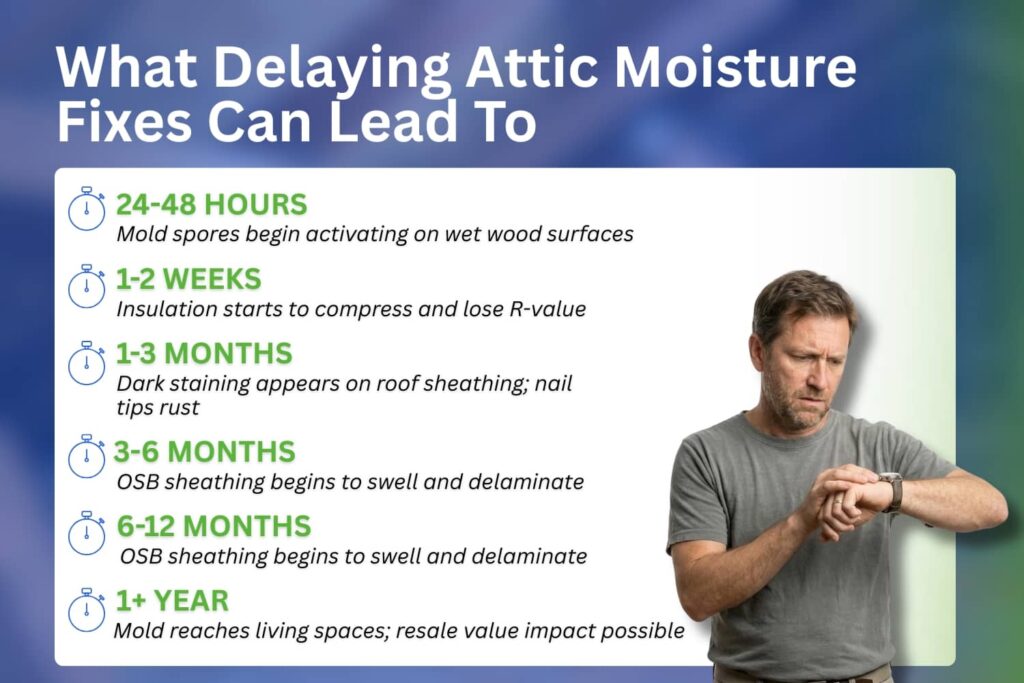
Mold needs two things to take hold: moisture and organic material. Roof sheathing and wood framing provide both. Under the right conditions, mold can begin developing within 24 to 48 hours of moisture exposure.
Research from Lawrence Berkeley National Lab estimates that roughly 47 to 50 percent of U.S. homes show evidence of dampness or mold, and attics are one of the most common locations.
Attic mold does not stay in the attic. Spores can travel through ceiling gaps and into living spaces, affecting the air quality throughout your home. If you are noticing unexplained respiratory symptoms or allergy flare-ups, it is worth checking whether your attic may be a contributing factor.
This article on 10 warning signs of mold toxicity covers what to watch for.
Wood rot and structural damage
Wood decay fungi become active when wood moisture content climbs above roughly 20 percent. OSB sheathing, the most common roof decking material in homes built after the 1970s, is especially vulnerable. It swells, softens, and can delaminate after repeated cycles of wetting and drying.
Freeze-thaw cycles compound the damage, mechanically breaking down wood fibers with each expansion and contraction.
Structural repairs to damaged framing and sheathing can run into thousands of dollars. Catching the problem at the condensation stage, before rot sets in, is significantly less expensive.
Insulation failure
Wet insulation compresses and loses its ability to resist heat transfer. This makes your home less energy efficient, drives up heating and cooling costs, and worsens the conditions that caused the condensation in the first place.
It is one of the more frustrating feedback loops in home performance: the damage makes the underlying problem worse.
Financial consequences
Mold remediation costs typically range from $1,223 to $3,753, depending on the extent of the growth. Sheathing replacement during re-roofing adds thousands more. And if mold history becomes part of a home’s record, it can affect resale value and buyer confidence significantly.
What Homeowners Can Do And When to Call a Professional
There are several things homeowners can check and address on their own. But there is also a clear point at which DIY efforts are not enough.
Homeowners can handle:
- Confirm that bathroom and kitchen exhaust fans vent to the exterior and not into the attic
- Check that the attic hatch is insulated and has a weatherstripped seal
- Look for blocked soffit vents from inside the attic along the eave line
- Monitor indoor humidity with a basic hygrometer (the EPA recommends keeping indoor RH between 30 and 50 percent)
- Run exhaust fans during showers and for at least 20 minutes afterward
- Avoid running a humidifier at high settings during cold weather without first verifying attic conditions
Here is a point, though, where the problem goes beyond what a checklist can fix. If you are seeing any of the following, it is time to bring in someone with the right tools and training to assess what is actually happening.
Call a professional when:
- Mold covers more than 10 square feet (the EPA’s general threshold for professional remediation)
- You notice soft, sagging, or discolored roof sheathing
- Water stains appear on upper-floor ceilings without a clear cause
- Musty odors persist despite efforts to lower indoor humidity
- You are buying or selling a home and want to understand the full condition of the attic
- Condensation or moisture keeps returning despite basic fixes
DOE and ENERGY STAR data show that proper air sealing and insulation save an average of 15 percent on heating and cooling costs.
What a Professional Home Inspection Covers in the Attic
A professional attic inspection goes well beyond a quick visual check. Here is what a qualified inspector evaluates during a thorough attic assessment.
- Structural condition: Roof sheathing, rafters, and framing are checked for moisture staining, mold, soft spots, rot, or frost accumulation.
- Insulation evaluation: The inspector assesses insulation type, depth, condition, and approximate R-value. Wet, compressed, or inadequate insulation is documented and noted.
- Ventilation assessment: Soffit vents, ridge vents, gable vents, and baffles are checked for blockage, damage, or improper installation. Ventilation balance is evaluated against code requirements.
- Exhaust fan verification: Every bathroom and kitchen exhaust fan termination is located and confirmed to exit to the exterior.
- Moisture readings: A moisture meter is used on sheathing, framing, and insulation. Readings above 20 percent signal active moisture concern.
- Thermal imaging: Infrared cameras detect hidden air leaks, cold spots, and wet insulation pockets that are invisible to the naked eye.
- Visible HVAC ductwork: Leaking ducts in an attic waste conditioned air and introduce additional moisture. This is checked as part of the overall attic assessment.
- Comprehensive written report: All findings are documented with photos and prioritized so homeowners understand what needs attention now versus what to monitor over time.
Related Questions
Can attic condensation cause mold?
Yes, and faster than most homeowners expect. Mold can begin developing within 24 to 48 hours when moisture and organic material are present. If you suspect mold is already present, professional mold testing is the most reliable way to assess the extent of the problem.
Is attic condensation the same as a roof leak?
No, though they can look similar. A roof leak is triggered by rain or snow melt and tends to be concentrated near flashings or damaged shingles. Attic condensation is triggered by temperature swings and is typically spread across sheathing and insulation surfaces.
Why is my attic wet in winter but not in summer?
Condensation requires a significant temperature difference between your indoor air and the attic surfaces. In summer, your attic is warm enough that rising air does not cool below the dew point. In winter, especially during the late-season freeze-thaw cycles common in Central PA, that temperature differential is at its greatest, and moisture transport through the stack effect is at its peak.
How do I know if my attic has enough ventilation?
The International Residential Code requires a minimum of one square foot of net free ventilation area for every 150 square feet of attic floor space. In practice, blocked soffit vents, missing baffles, and unbalanced intake-to-exhaust ratios are extremely common findings in older homes.
Who should I call for attic condensation, a roofer, or a home inspector?
Starting with a home inspector is usually the better first step. A roofer will evaluate the roof system for damage and may recommend repairs or replacement, but if the root cause is an air sealing problem, inadequate ventilation, or an exhaust fan terminating in the wrong place, a new roof will not fix it.
Take the Guesswork Out of Your Attic
Attic condensation is a common problem, but it is also a solvable one, as long as it is caught before mold takes hold or structural damage sets in. For homeowners in Harrisburg and across Central Pennsylvania, late winter and early spring are the highest-risk months.
If you have noticed any of the warning signs covered in this post, or if it has simply been a while since anyone has looked at your attic, a professional home inspection is the most straightforward way to get a clear, honest picture of what is happening up there.
Schedule your home inspection with Enviroquest today, or if mold is already a concern in your home, ask about our mold testing services as well.