
Pennsylvania homes face four main types of water contamination: biological, chemical, physical, and radiological.
In fact, many of the most dangerous contaminants have no color, odor, or taste. Therefor, the only reliable way to protect your household is to test your water.
At Enviroquest, our certified inspectors test for all of them. Specifically, this guide covers what those contaminants are, where they come from in Central PA.
Particularly, it explains when a professional water test makes sense.
The Four Main Categories of Water Contaminants
The EPA classifies drinking water contaminants into four categories: biological, chemical, physical, and radiological.
Generally speaking, each reaches your water through different pathways and poses different health risks. Consequently, here is what each one means for PA homeowners:
| Category | Examples | Detectable by sight/smell? |
|---|---|---|
| Biological | Bacteria, viruses, Giardia | Usually not |
| Chemical | Lead, nitrates, PFAS, arsenic | No |
| Physical | Sediment, turbidity | Sometimes |
| Radiological | Radon, uranium, radium | No |
Biological Contaminants
Basically, biological contaminants are living microorganisms that enter water through contaminated sources. For instance, bacteria are the most common concern for PA well owners.
Coliform bacteria and E. coli enter well water through failing septic systems, livestock runoff, and surface water infiltration.
As a result, these are common in the rural and exurban areas around Dauphin and Cumberland counties.
Other biological contaminants include:
- Viruses (norovirus, hepatitis A): typically enter water from sewage or septic system failures
- Protozoa (Giardia, Cryptosporidium): resistant to standard chlorine doses; enter water from animal waste and surface water
- Iron bacteria: basically, it is not harmful to drink, but causes foul odors and orange staining in well water. This is a common issue across Central PA groundwater
Coliform bacteria and E. coli are tested in every standard water screening at Enviroquest.
Chemical Contaminants
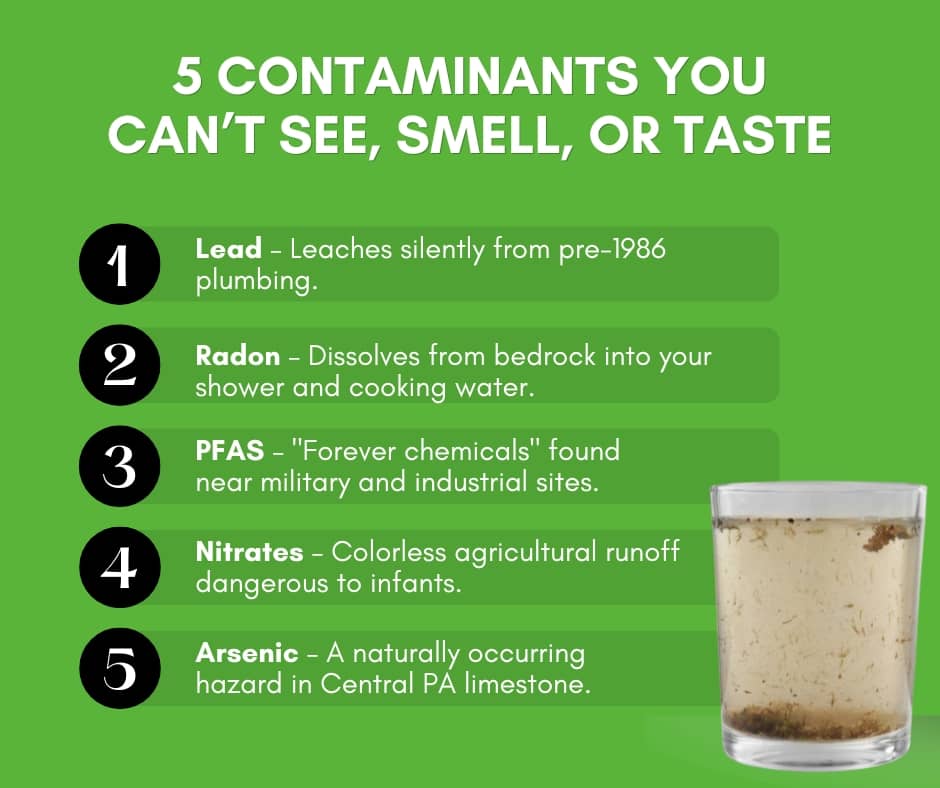
Chemical contaminants are a broad category covering heavy metals, agricultural chemicals, industrial byproducts, and disinfection byproducts. Most are invisible and tasteless.
1) Lead is one of the most serious concerns in older PA homes. Generally, lead enters tap water through corroding pipes and fittings rather than the water supply itself.
Consequently, pre-1986 construction in Harrisburg and throughout Dauphin County carries the highest risk. After all, lead solder and lead service lines were standard before that year.
2) Nitrates come from fertilizer runoff and septic leachate. They are colorless and tasteless. High nitrate levels are dangerous for infants under six months, causing methemoglobinemia (low blood oxygen, sometimes called blue baby syndrome).
The Cumberland Valley’s intensive agricultural activity makes nitrate contamination a real concern for private well owners in the region.
3) PFAS (per- and polyfluoroalkyl substances) are synthetic chemicals used in firefighting foam, nonstick coatings, and industrial processes. They do not break down in the environment, which is why they are called “forever chemicals.”
For instance, several military installations near Harrisburg, including Carlisle Barracks, are documented PFAS sources. The EPA finalized maximum contaminant levels for PFOA and PFOS in 2024, setting a limit of 4 parts per trillion.
4) Arsenic occurs naturally in Pennsylvania’s bedrock geology. Private well owners drawing from granite and limestone aquifers in the region may have elevated arsenic levels with no industrial source nearby.
Other chemical contaminants covered in standard testing include total dissolved solids (TDS), disinfection byproducts, volatile organic compounds (VOCs), copper, and zinc from corroded plumbing.
Physical Contaminants
Physical contaminants are measurable particles in water. Turbidity (cloudiness) is the most common indicator.
Sediment, silt, and suspended solids enter well water after heavy rain, flooding, or a well casing failure.
Physical contamination rarely causes immediate health effects on its own. However, high turbidity can shield biological contaminants from disinfection, making it an important screening factor. Therefore, visual clarity is a key warning sign.
In fact, the causes of cloudy tap water can range from completely harmless air bubbles to severe sediment infiltration that warrants further testing.
Radiological Contaminants
Radiological contaminants include radon, uranium, and radium.
Pennsylvania consistently ranks among the highest states for radon, and dissolved radon in well water is a separate exposure pathway from the airborne radon in your home’s soil and foundation.
In addition, well water drawn from granite and limestone aquifers in Central PA can carry dissolved radon. As a result, it releases into the air as a gas whenever you are showering or cooking.
John Staz, our PA DEP Certified Radon Tester, includes radon screening in comprehensive water quality assessments at Enviroquest.
Water Contamination Sources Common in Pennsylvania
Knowing where contamination comes from helps you assess your own home’s risk. The CDC identifies several main contamination pathways for household drinking water.
- Private wells are unregulated. Well water quality in Pennsylvania is not monitored by any state agency between ownership changes. PA DEP recommends testing your well annually. If you have never tested your well, you have no way of knowing what is in it.
- Aging municipal infrastructure affects city water users in older neighborhoods. Municipal water meets EPA standards at the treatment plant. Unfortunately, lead can easily leach from service lines and household plumbing between the plant and your tap. For this reason, homes with original plumbing from before 1986 face a severe risk. Specifically, this danger exists regardless of your water utility’s corrosion control program.
- Agricultural runoff is the primary source of nitrates, pesticides, and herbicides in groundwater across the South Mountain region and the Cumberland Valley. The same farming activity that makes this region productive also means elevated nitrate rates in private wells nearby.
- Industrial and military sources are the main PFAS pathway in Central PA. Residents near documented PFAS sites have measurable risk in private wells, and PFAS does not decrease over time.
- Septic system failures introduce bacteria, nitrates, and viruses into nearby wells. For example, older systems that have been in place for 20 to 25 years require close attention. Therefore, these properties (along with homes on lots with nearby livestock) are the most common candidates for testing across Dauphin and Cumberland counties.
Health Risks from Contaminated Drinking Water
The health risks from contaminated water depend on what you are exposed to, how much, and for how long. Short-term biological contamination causes acute illness.
Long-term chemical or radiological exposure is linked to serious chronic conditions.
| Contaminant | Primary health risk | Most at risk |
|---|---|---|
| Lead | Neurological damage, developmental delay | Children, pregnant women |
| Nitrates | Methemoglobinemia (blue baby syndrome) | Infants under 6 months |
| PFAS | Thyroid disease, kidney and testicular cancer, immune suppression | All ages, cumulative |
| E. coli / coliform bacteria | Gastrointestinal illness | All ages; serious for elderly/immunocompromised |
| Arsenic | Bladder and skin cancer (long-term exposure) | All ages |
| Radon (via water) | Lung cancer from inhaled gas | All household members |
One pattern shows up across all of these: most of the most harmful contaminants give no warning. Lead, arsenic, PFAS, nitrates, and radon are all colorless, odorless, and tasteless.
A glass of water contaminated with any of them looks completely normal.
Related Questions to Explore
What are the four main types of drinking water contaminants?
The four types are biological (bacteria, viruses, protozoa), chemical (lead, nitrates, PFAS, arsenic), physical (sediment, turbidity), and radiological (radon, uranium, radium). Generally speaking, the EPA defines a contaminant as any substance other than water itself. Nevertheless, it is important to note that not all contaminants cause harm at low concentrations.
Can water look clean and still be contaminated?
Yes. Most of the most dangerous contaminants in PA drinking water have no color, odor, or taste. Lead, arsenic, PFAS, nitrates, and radon are all undetectable by sight or smell. Visual inspection is not a substitute for a certified water test.
What are the most common contaminants found in Pennsylvania well water?
Pennsylvania well owners most commonly encounter coliform bacteria, E. coli, iron, manganese, nitrates, hardness minerals (calcium, magnesium), arsenic, and radon. PFAS is an emerging concern near military installations and industrial sites. Penn State Extension’s private well water guidance is a useful reference for PA-specific baseline risks. For results you can act on, a certified lab test through Enviroquest covers all of these in one visit.
If you have noticed brown or orange tints, that typically points to iron or manganese in your well water. In fact, this is a very common issue in Central PA groundwater that a basic test will confirm.
How do I know if my tap water has lead in it?
You cannot detect lead by looking at, smelling, or tasting your water. Lead leaches silently from corroded pipes and fixtures. Specifically, the risk is highest in homes built before 1986, when lead solder and lead service lines were still standard. A certified water test is the only reliable detection method.
For example, if you are buying or selling a home in Harrisburg or the surrounding area, testing is part of a thorough assessment. Our water testing service includes lead as a standard line item.
When to Call a Professional
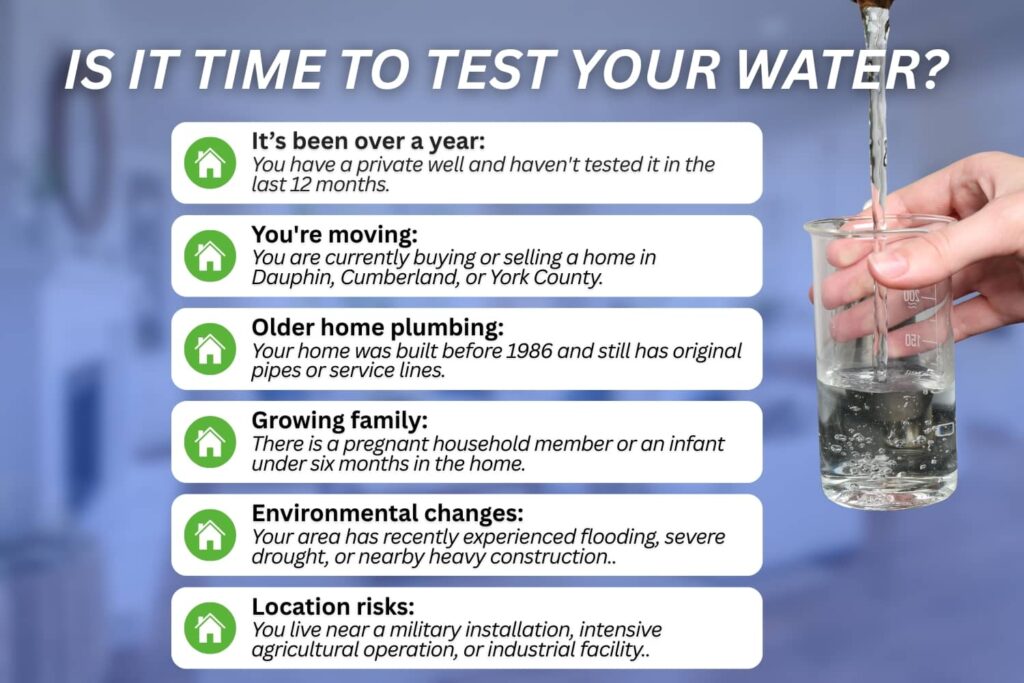
Schedule a professional water test if any of the following apply to your home:
- You have a private well and have not tested in the past 12 months (PA DEP recommends annual testing)
- You are buying or selling a home in Dauphin, Cumberland, or York County
- Your home was built before 1986 and has original plumbing or service lines
- You have an infant under six months or a pregnant household member
- A neighbor’s well has recently shown contamination
- Your area has had flooding, drought, or nearby construction that could affect groundwater
- Your water has developed a new taste, odor, or appearance
- Your home is near a military installation, agricultural operation, or industrial facility
John Staz has completed over 15,000 inspections across Central Pennsylvania in 27 years and holds certifications from ASHI, InterNACHI, and PA DEP.
Enviroquest’s water testing covers bacteria, E. coli, lead, nitrates, total dissolved solids, and additional contaminants based on your location and risk factors. Schedule your assessment through our water testing services page.
Conclusion
Pennsylvania homes face real contamination risks from biological, chemical, physical, and radiological sources. Lead, nitrates, PFAS, bacteria, iron, and radon are among the most common concerns in Central PA. Most are invisible without testing.
Key takeaways:
- Most dangerous contaminants (lead, arsenic, PFAS, radon, nitrates) have no color, taste, or smell
- Private wells need annual testing; municipal water users should test for lead in household plumbing
- Pennsylvania has specific risks: PFAS near military sites, nitrates in agricultural areas, and radon in granite and limestone aquifer zones
Ready to find out what is in your water? Contact Enviroquest to schedule a certified water test for your home.