
You found small, round holes in your hardwood floors and a pile of fine powder nearby. Or your home inspection report came back flagging wood-destroying insect activity. Either way, your first question is the same: is this a termite or powderpost beetle infestation?
Both are wood-destroying organisms (WDOs) that can compromise the structural integrity of a home, but they look different, behave differently, and require completely different treatment.
At Enviroquest, we have inspected thousands of Central Pennsylvania homes for exactly this kind of damage.
This guide walks you through the key differences, what each sign means, and when to get a professional WDI inspection.
What Are Powderpost Beetles?
Powderpost beetles are the second most destructive wood-boring insect in the United States, after termites. Their larvae bore through wood for months or years, leaving behind a network of tunnels packed with fine, powdery frass.
When larvae mature and emerge as adults, they exit through small round holes roughly 1/16 to 1/8 inch in diameter.
Three families fall under the powderpost label, and they do not all behave the same:
- Lyctid beetles target hardwoods with large pores: oak, ash, hickory, and walnut. They are the most common cause of damage to hardwood floors, wood trim, and furniture in homes.
- Anobiid beetles prefer older softwoods like pine and spruce. In Central Pennsylvania’s older housing stock, Anobiids are frequently found in crawl space timbers and unfinished basement framing.
- Bostrichid beetles target both hard and softwoods and sometimes show up in bamboo flooring and imported wood products.
One detail that surprises many homeowners: powderpost beetles almost always enter a home through infested wood.
They arrive in new lumber used during construction, antique furniture, or firewood brought inside. The infestation does not come from the soil the way termites do.
What Are Termites?
Termites are social insects that consume cellulose, the compound that gives wood its structure. In Pennsylvania, the Eastern Subterranean Termite (Reticulitermes flavipes) is by far the most common species.
A mature colony can contain hundreds of thousands of workers feeding continuously, which is why termites cause faster structural damage than beetles.
Subterranean termites live underground and tunnel up through soil to reach wood in your home’s foundation, floor joists, and wall framing.
Their most recognizable sign is the mud tube: a pencil-width tunnel made of soil, saliva, and wood particles, running up a foundation wall, pier, or crawl space framing.
Unlike powderpost beetles, termites rarely break through the wood surface. They leave smooth, clean galleries inside that follow the wood grain, and the surface can look completely intact until it fails under weight.
Other signs of termite activity:
- Discarded wings near windowsills or entry points during swarm season (spring in Central PA)
- Wood that sounds hollow when tapped with a screwdriver
- Sagging floors or doors that no longer close properly in more advanced cases
Powderpost Beetles vs. Termites: Key Differences
Here is a direct comparison of the two most common wood-destroying organisms found in Central Pennsylvania homes:
| Feature | Powderpost Beetles | Subterranean Termites |
|---|---|---|
| Visible sign | Round exit holes + fine powder | Mud tubes + clean internal galleries |
| Frass (waste) | Fine, powdery (cream = active; gray = old) | None visible (subterranean species) |
| Wood preference | Hardwood (Lyctid) or softwood (Anobiid) | Any cellulose-containing wood |
| Entry point | Infested lumber, furniture, and firewood | Soil-to-wood contact, foundation cracks |
| Colony structure | No colony — solitary larvae | Up to hundreds of thousands of workers |
| Damage speed | Slower, localized | Faster, widespread |
| Treatment | Borate treatment or fumigation | Soil termiticide barrier or bait system |
How to Distinguish Frass from Other Debris
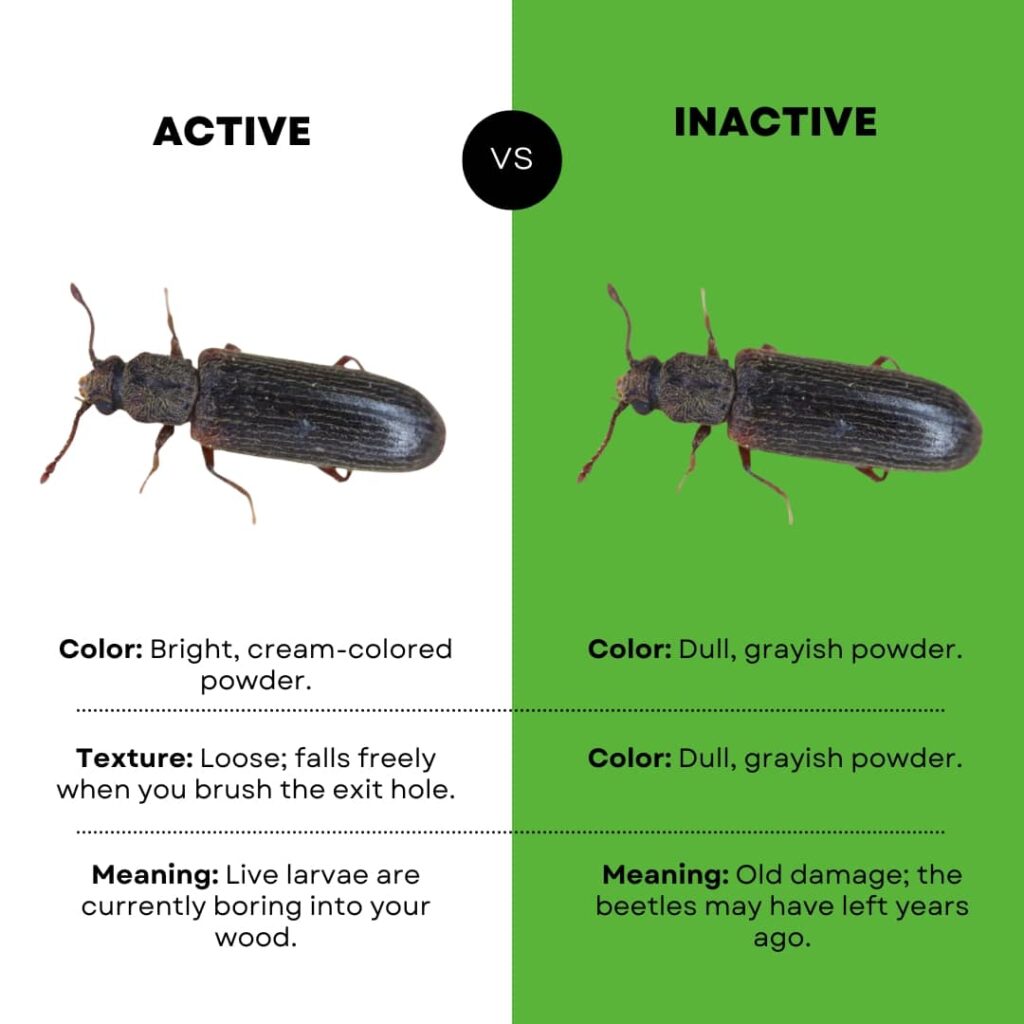
The frass powderpost beetles leave behind is one of the clearest identifiers. Fresh, cream-colored frass that falls freely when you brush the exit hole means the infestation is active. Compacted, grayish frass that stays in place suggests the infestation has been inactive for years, possibly decades.
This distinction matters significantly for treatment decisions and real estate negotiations. According to the University of Maryland Extension’s guide on powderpost beetles, beetle infestations can remain hidden inside wood for extended periods before adult emergence begins, making the frass color and consistency the most reliable field indicator of active versus inactive activity.
Termite frass is not visible with subterranean species. What you see instead are mud tubes and hollow galleries inside wood.
Where Each Pest Does Its Damage
Powderpost beetle damage tends to cluster in one area. Groups of exit holes appear in a specific piece of wood: hardwood floors, interior trim, or structural timbers in a crawl space. The surrounding wood may feel solid while the interior is riddled with tunnels.
Termite damage concentrates in structural framing: floor joists, sill plates, and wall studs. Damage in these locations puts the structural integrity of the home at greater risk more quickly.
How Each Pest Enters Your Home
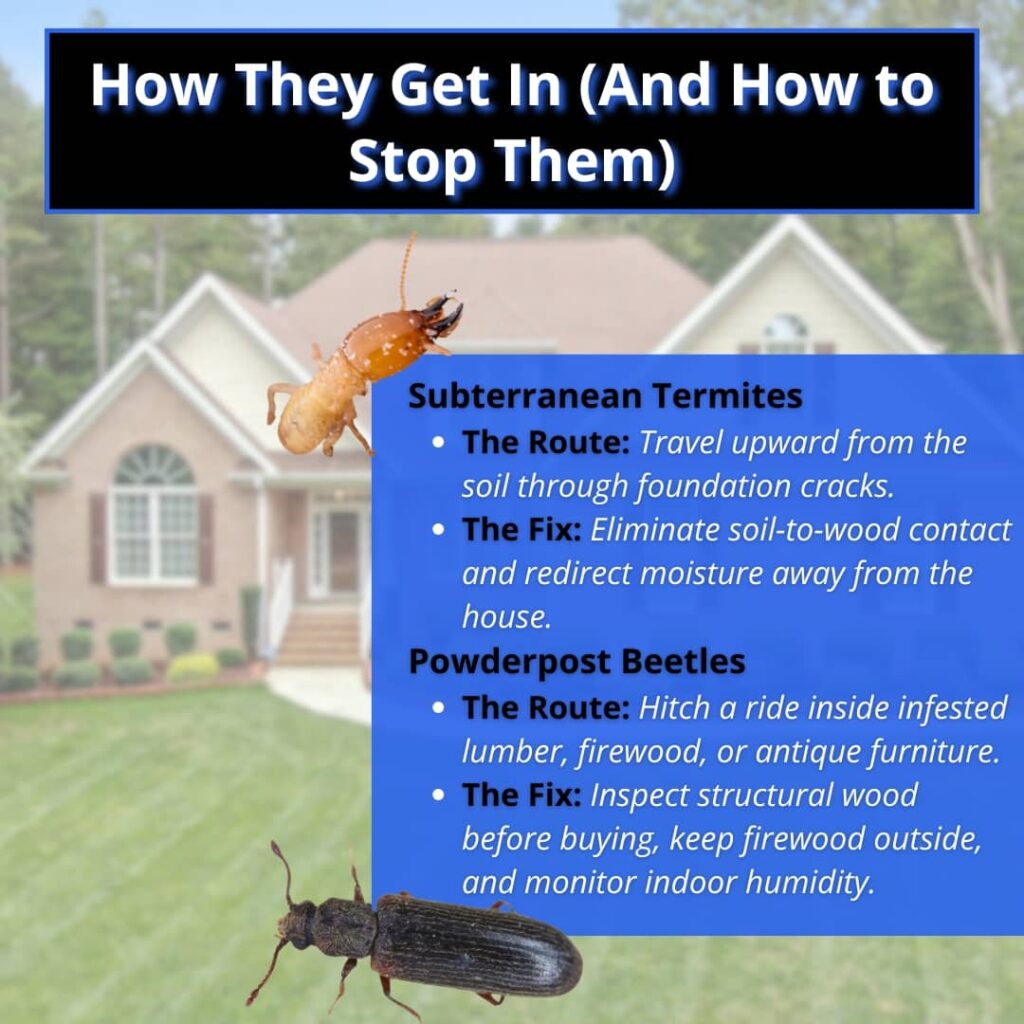
Termites move from the soil upward. Managing them starts with reducing soil-to-wood contact, maintaining drainage away from the foundation, and addressing moisture issues under the home.
Powderpost beetles arrive with infested wood.
This is why a newly built home can have a beetle infestation even without any prior pest history on the property, and why a thorough WDI inspection matters for new construction as well as older homes.
Treatment: What It Takes to Get Rid of Each
Neither pest responds reliably to DIY products once a structural infestation is established.
For termites, a licensed pest control operator typically applies a liquid termiticide to the soil around the foundation to create a treated zone, installs a bait system, or uses a combination of both. Complete colony elimination may take several months, and annual monitoring is standard practice afterward.
For powderpost beetles, treatment depends on the beetle family and the extent of the infestation. Borate-based products applied to bare, accessible wood (crawl space framing, subfloor) kill larvae and prevent re-infestation. Finished wood or furniture in severe cases may require fumigation.
Fumigation for beetles requires approximately 10 times the fumigant concentration compared to termite treatment and a longer tent period, often six days, compared to three or four days for termites.
Many homeowners underestimate the complexity and cost of beetle treatment before a proper identification is done. Penn State Extension’s resources on wood-destroying insects cover identification and treatment options in more detail for Pennsylvania homeowners.
Enviroquest does not provide pest treatment. Our role is to identify and document evidence of wood-destroying insect activity through a licensed WDI inspection.
That inspection satisfies mortgage lender requirements in Pennsylvania for VA and conventional loans, and it gives both buyers and sellers a clear picture of what they are dealing with before any treatment decision is made.
If you are buying a home in Harrisburg, Lancaster, York, Dover, or the surrounding Central PA areas and your inspection report flagged WDO activity, our Wood Destroying Insect Inspection service provides the documentation you need.
Related Questions to Explore
How do I know if I have powderpost beetles or termites?
Look for exit holes and fine powder for beetles; look for mud tubes, hollow wood, or discarded wings for termites. The frass is the fastest field identifier: beetle frass is fine and powdery, cream-colored when active. Subterranean termites leave no visible frass at all. A licensed WDI inspection will identify the pest, confirm whether the activity is active or inactive, and document the findings in a report.
What does powderpost beetle damage look like vs. termite damage?
Beetle damage appears as clusters of small, round holes (1/16 to 1/8 inch) with powdery residue around them. The wood may feel solid on the surface while hollow inside. Termite damage shows as wood with clean, smooth internal galleries running along the grain, often with a paper-thin surface that crumbles under pressure. Tapping with a screwdriver that returns a hollow sound is a common sign of termite activity. Our post on whether termites have wings covers additional visual identification for termite activity in Central PA.
Are powderpost beetles harder to get rid of than termites?
In some ways, yes. Because beetle larvae can remain dormant inside wood for years, it can be difficult to confirm that a treatment has been fully effective. Fumigation for beetles also requires a higher concentration and longer tent period than termite treatment. That said, termites cause more widespread structural damage at scale and are generally the higher-risk pest for a home’s structural integrity.
Can powderpost beetles cause structural damage to a house?
Yes, particularly Anobiid beetles, which target softwood framing timbers in crawl spaces and basements. Left untreated for years, an Anobiid infestation can weaken floor joists and structural beams to the point where repair is necessary. The risk is lower than with a mature termite colony, but a long-term infestation in structural wood is not something to dismiss. If you are weighing a purchase decision after a WDI report, our post on when to walk away after a home inspection gives practical guidance on what different findings mean for buyers.
When to Call a Professional
Call a licensed pest control operator when you have a confirmed active infestation and need treatment. Call Enviroquest when you need a WDI inspection before purchasing a home, when a lender requires a WDI report, or when you have found signs of wood-destroying insect activity and need a professional determination of what you are looking at and whether it is currently active.
Enviroquest’s owner, John Staz, is an ASHI Certified Inspector with more than 15,000 inspections completed in Central Pennsylvania and a Pennsylvania pest applicator license.
That combination of credentials means a WDI inspection from Enviroquest is not a checkbox: it is a thorough assessment by an inspector who has identified beetle and termite activity across thousands of Harrisburg, Lancaster, and York area properties.
A WDI inspection is typically required for VA loans and is a standard add-on for conventional home purchases throughout Central PA.
If your current inspector does not include WDI inspection as part of their scope, that is worth asking about before you close.
Conclusion
Powderpost beetles and termites are not the same pest, and they do not have the same solution. Beetles leave powdery frass and round exit holes; termites leave mud tubes and smooth internal galleries.
Beetles enter through infested wood; termites travel from the soil. Treatment for each is different, and the cost and complexity vary significantly depending on which pest you have and how far the activity has spread.
If you are buying a home in Central Pennsylvania and a WDI inspection report flagged activity, or if you have found signs of damage and need to know what you are dealing with, schedule a WDI inspection with Enviroquest. We serve Harrisburg, Lancaster, York, and the surrounding areas.