
A radon mitigation system lowers the radon gas in your home by pulling it out from under the foundation and venting it safely above the roof.
When one is designed and installed correctly, it drops radon below the EPA action level of 4 pCi/L and keeps it there for years.
When it fails, radon creeps back, often without any obvious sign. At Enviroquest, we have installed and serviced radon systems across Central Pennsylvania since 1991, and most “failures” we see trace back to a handful of avoidable causes.
This guide walks through the main types of systems, how they work, why they fail, and the warning signs to watch for.
What Is a Radon Mitigation System and How Does It Work?
A radon mitigation system is a fan and pipe assembly that creates suction beneath your foundation, captures radon-laden soil gas before it enters your living space, and exhausts it above the roofline where it disperses harmlessly.
The core idea is negative pressure. A continuously running inline fan pulls air from a suction point in the slab, crawl space, or drain system.
That draw lowers the air pressure under the foundation below the pressure inside your home, so soil gas follows the pipe up and out instead of seeping through cracks and joints.
A U-tube gauge called a manometer confirms the system is holding suction.
Radon is the second leading cause of lung cancer in the United States, according to the EPA’s radon guidance, which is why a working system matters so much in high-radon regions.
For a deeper walk-through of the parts and the airflow path, see our companion post on how a radon mitigation system works.
Types of Radon Mitigation Systems
There is no single “radon system.” The right design depends on your foundation, the soil beneath it, and how radon is entering. Below are the main types, what they do, and where they fit.
| System type | How it works | Best for | Notes |
|---|---|---|---|
| Active sub-slab depressurization (ASD) | Fan draws soil gas from a suction point cut into the slab and vents it above the roof | Basements and slab-on-grade homes | Most common and most effective method |
| Sub-membrane depressurization | Sealed plastic membrane over the dirt floor; a pipe draws gas from beneath it | Crawl spaces | Enviroquest uses 6-mil sealed sheeting |
| Drain-tile depressurization | Taps the home’s existing perimeter drain tile as the suction point | Homes with functioning drain tile | Efficient when drain tile loops the footprint |
| Block-wall depressurization | Draws radon from the hollow voids of block foundation walls | Hollow block foundations | Often paired with sub-slab suction |
| Sump-pit depressurization | Seals the sump pit with an airtight lid and vents it with a fan | Homes with an open sump | Keeps the sump usable while sealing the entry point |
| Passive system | Uses the natural stack effect, no fan | New construction with builder-installed pipe | Frequently underperforms; usually needs a fan added |
| HRV / ventilation | Balanced air exchange dilutes indoor radon | Supplemental use | Rarely enough on its own |
Enviroquest installs sub-slab suction, sub-membrane depressurization for crawl spaces, drain-tile suction, block-wall suction, and passive-to-active conversions.
One design choice sets our systems apart: we run 4-inch pipe rather than the 3-inch pipe many installers use.
Wider pipe moves far more air at lower fan strain, which helps the system hold suction over the long haul.
If your builder left a capped pipe in place, we can often activate that passive system rather than start from scratch. You can compare options on our radon mitigation services page.
The Main Reasons Radon Mitigation Systems Fail
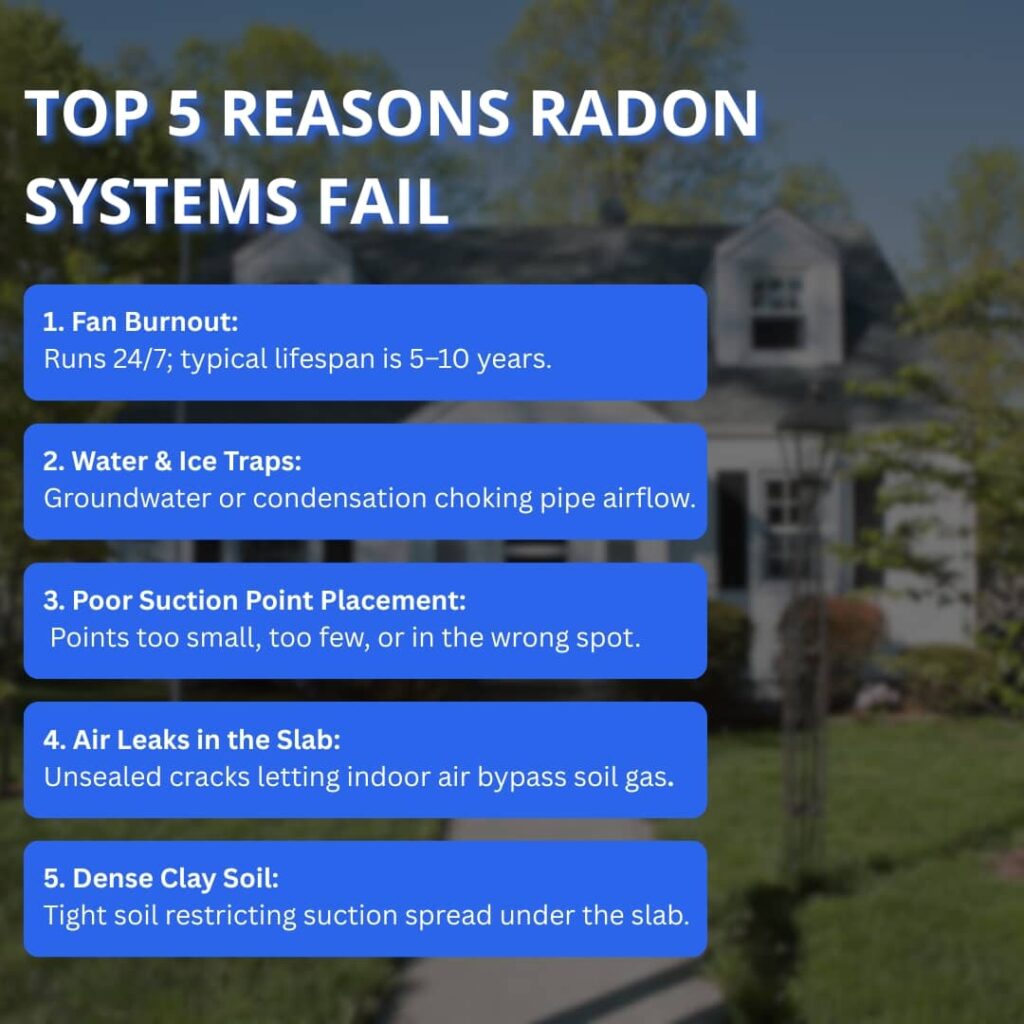
When radon comes back after mitigation, the method rarely fails. The design or install did. Here are the causes we diagnose most often.
Fan failure
The fan is the only moving part, and it runs 24 hours a day, every day. Over roughly 5 to 10 years, bearings wear out, or the motor burns out. A dead fan means zero suction, and radon returns within days. A fan that grinds, rattles, or changes pitch is warning you it is on the way out.
Water under or inside the system
Groundwater is the quiet system-killer in Pennsylvania. A high water table under the slab can block the soil gas path so the fan cannot pull from the ground.
Water can also condense inside the vent pipe and pool at a low spot or a sag, choking airflow. In winter, that trapped moisture can freeze and fully block the pipe.
Suction points that are too small, too few, or misplaced
A suction point that is too small starves the system of the airflow it needs. Large homes and homes with divided foundations often need more than one suction point. Put the point in the wrong spot, over dense or compacted fill, and the fan pulls air but not radon.
Inadequate sealing
Depressurization only works if the slab is reasonably sealed. Open cracks, unsealed control joints, gaps around plumbing penetrations, and an uncovered sump pit all let conditioned indoor air get sucked into the system instead of soil gas. The fan works hard and accomplishes little.
Soil that resists sub-slab suction
Tight, clay-heavy, or poorly draining soil does not let the fan spread its suction field far beneath the slab. In those cases, a single sub-slab point may not be enough, and the design has to change, sometimes to multiple points or a different suction strategy entirely. This is why diagnostic pressure-field testing before install matters.
Warning Signs Your Radon System Isn’t Working
The clearest sign of a failing system is a manometer reading that has gone flat. The rest you can check in a couple of minutes.
Your manometer is the small U-shaped tube mounted on the vent pipe, partly filled with colored liquid. When the system is running, the liquid sits at two different heights on the two sides of the U.
If the two columns are level and even, there is no suction, which usually means the fan has failed or lost power. Snap a photo of the reading when your system is installed so you have a healthy baseline to compare against.
Other signs to watch for:
- The fan is silent when you put your hand near it, or it rattles, hums louder than usual, or changes pitch.
- A follow-up radon test comes back at or above 4 pCi/L even though the system is running.
- You notice water sounds, gurgling, or visible condensation collecting in the pipe.
- Ice forms on or in the exterior portion of the vent pipe during a cold snap.
Because radon is invisible and, as we cover in our post on whether radon has a smell, odorless, a periodic radon test is the only way to confirm the system is actually keeping levels down.
How to Keep Your Radon System Working
A radon system needs very little maintenance, but the little it needs is non-negotiable. Build these habits:
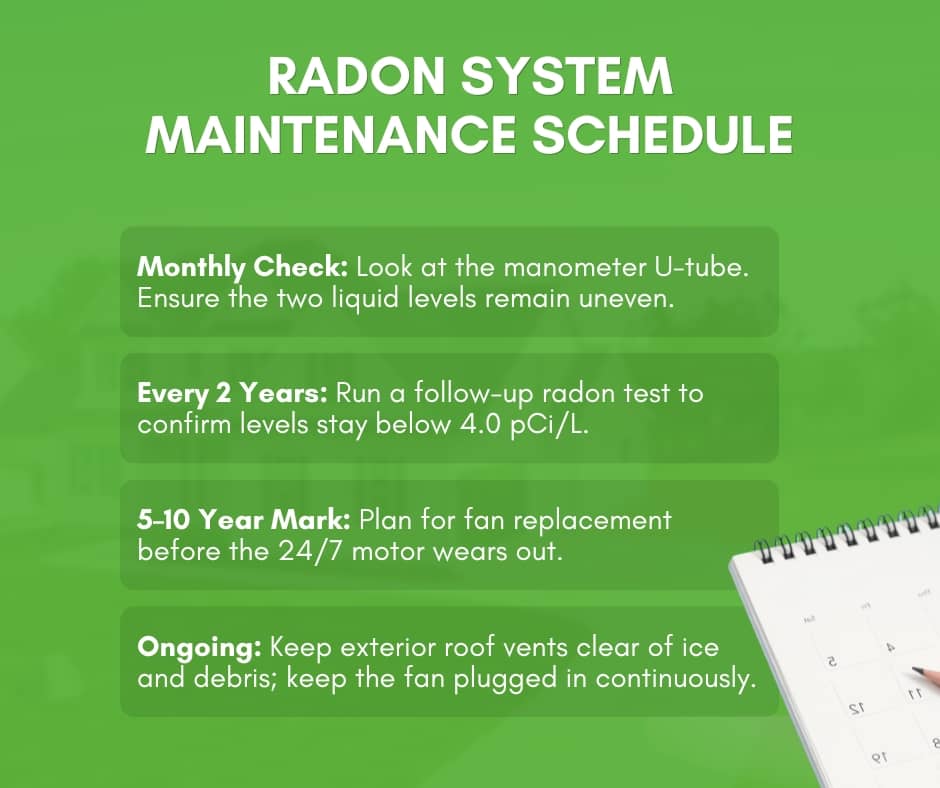
- Glance at the manometer monthly. Uneven liquid is good. Level liquid means call for service.
- Retest every two years, and after any major foundation work, renovation, or basement finishing. New cracks and new openings change the pressure balance.
- Plan for a fan replacement around the 5-to-10-year mark. Fans are consumable parts, not lifetime components.
- Keep the exterior vent clear of nests, debris, and ice, and make sure the discharge point stays above the roofline.
- Never disconnect or unplug the fan. The system only protects you while it runs continuously.
Pennsylvania sits in one of the highest-radon regions in the country, so staying on top of this matters more here than almost anywhere.
The Pennsylvania DEP Radon Division requires that anyone testing or mitigating radon in the state be DEP-certified, which is worth confirming before you hire anyone to service your system.
Related Questions to Explore
How much does a radon mitigation system cost?
Most residential radon mitigation systems fall in the range of roughly $800 to $1,500 installed, depending on foundation type, the number of suction points, and how the pipe has to be routed. Complex crawl spaces, multiple suction points, or difficult routing push the price up. Get a written, itemized quote so you can see what you are paying for.
Can a house still fail a radon test after mitigation?
Yes. A post-mitigation test above 4 pCi/L is the most common reason homeowners call us back. It almost always points to an install issue such as too few suction points, poor sealing, or an undersized fan, rather than the method failing. A proper diagnosis identifies the weak link and corrects it.
How do I read my radon manometer?
Look at the two liquid columns in the U-tube. If they sit at different heights, the fan is pulling suction, and the system is working. If the two columns are level, there is no suction and the system needs attention. The exact number matters less than the difference between the two sides.
How long does a radon fan last?
Radon fans typically last 5 to 10 years of continuous operation. Because the fan runs nonstop, it is the part most likely to fail first, so budget for an eventual replacement and act quickly if you hear new noise or see the manometer go flat.
Is a passive radon system as good as an active one?
Usually not. Passive systems rely on natural air movement and often fail to get radon below the action level, especially in high-radon areas. The good news is that a passive system can usually be upgraded to an active one by adding a fan, rather than rebuilding it.
Does a silent, running system mean it’s working?
No. A quiet system can still be failing. Silence only tells you the fan motor may be intact. The manometer and a follow-up radon test are what actually confirm the system is keeping radon out.
When to Call a Professional
Call a certified radon professional when your manometer reads level, the fan is noisy or silent, a retest comes back high, or your system is more than about seven years old and has never been checked.
Adding suction points, resizing a fan, resealing a slab, and diagnosing why radon is still elevated are all jobs that require the right equipment and PA DEP certification.
Enviroquest has designed and installed tens of thousands of radon systems across the Harrisburg area since 1991, and we also service systems installed by other companies.
Most of our installations are backed by a multi-year guarantee, and we serve homeowners throughout Dauphin, Cumberland, York, Lancaster, and Lebanon counties.
If your system needs a second look, contact our team for an honest evaluation.
Conclusion
Radon mitigation systems are simple machines that do a serious job, and they only work when they are designed for your home and maintained over time.
- The most effective systems for Central PA homes are active sub-slab and sub-membrane depressurization, ideally run through wider 4-inch pipe.
- Most failures come from fan burnout, water in the system, too few or misplaced suction points, or poor sealing, not from the method itself.
- Watch your manometer, retest every two years, and plan for a fan replacement.
If you are unsure whether your system is still protecting your family, the safest next step is a professional evaluation and a fresh radon test. Learn more about our radon mitigation in Harrisburg and schedule an assessment.