
Radon levels are highest during winter, typically between October and April. When your home seals up against the cold, radon gas accumulates indoors instead of escaping outside.
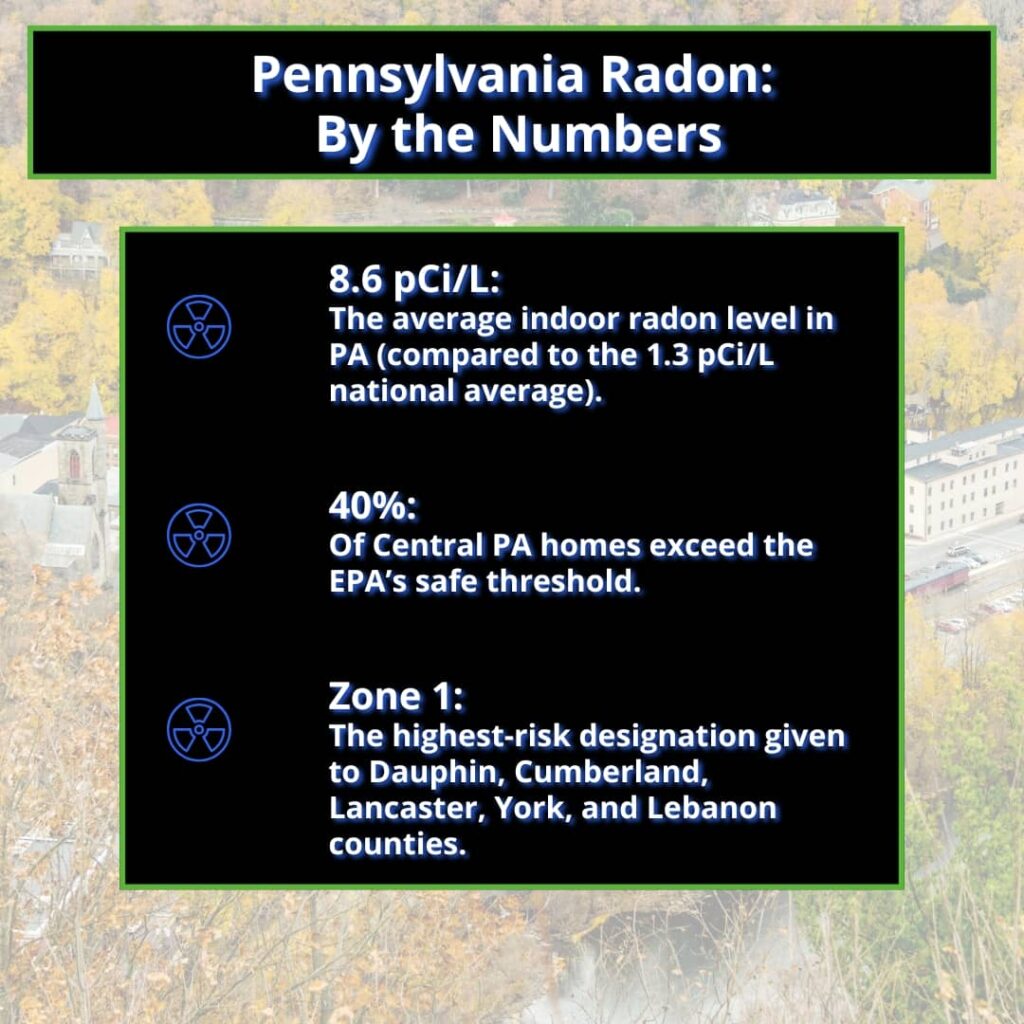
In Central Pennsylvania, where Dauphin County falls into the EPA’s highest-risk Zone 1 and roughly 40% of homes exceed the safe threshold of 4 picocuries per liter (pCi/L), this seasonal spike matters.
At Enviroquest, we have tested and mitigated radon in the Harrisburg area for more than 30 years. Here is what drives the seasonal pattern, when to schedule a test, and how to protect your family year-round.
Why Are Radon Levels the Highest During Winter?
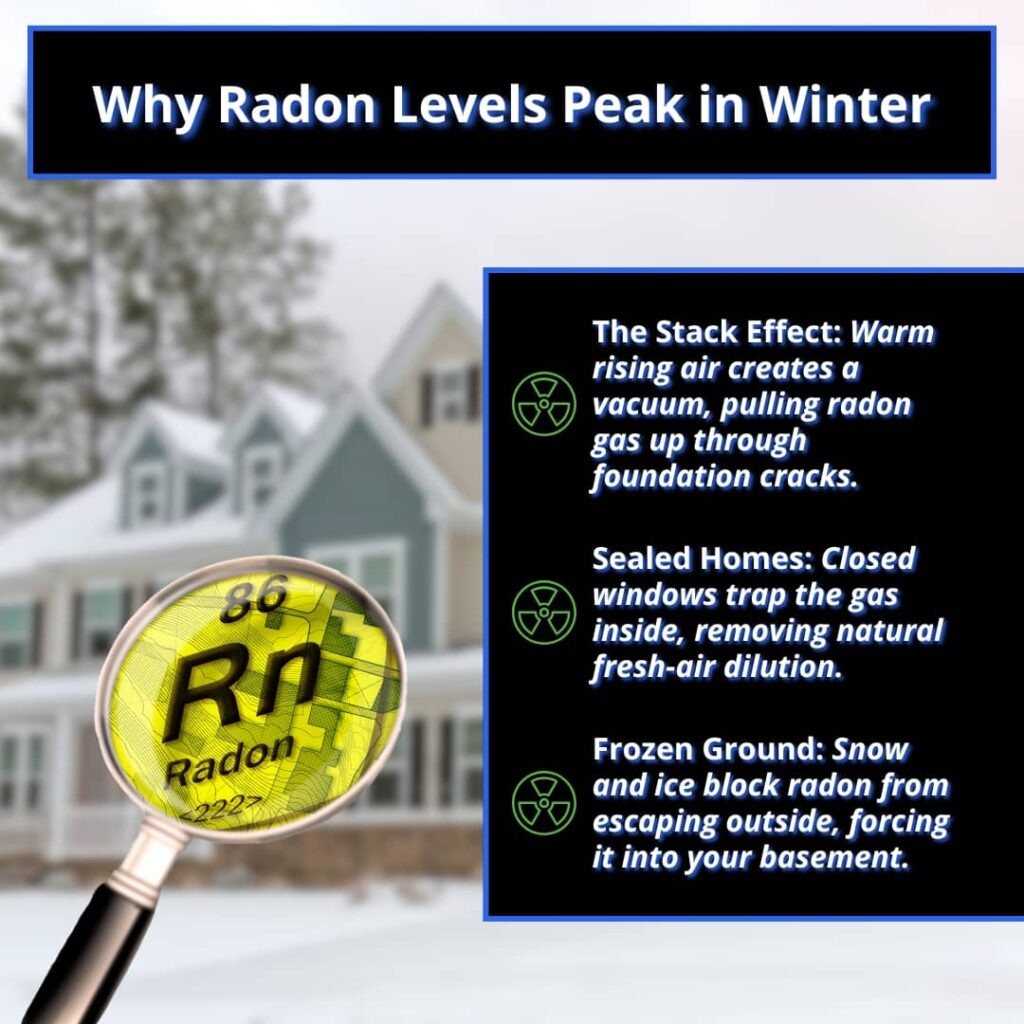
Radon concentrations peak in winter because three forces work together to pull the gas into your home and keep it there.
1. The Stack Effect Pulls Radon In
Warm air rises. In winter, the heated air inside your home climbs toward the ceiling and escapes through gaps in the upper floors, attic, and roof.
As it leaves, it creates negative pressure at the bottom of your home. That negative pressure acts like a vacuum, drawing soil gases up through foundation cracks, gaps around pipes, sump pump openings, and exposed earth in crawl spaces.
The colder the outdoor air, the bigger the indoor-outdoor temperature gap, and the stronger the pull. During a Harrisburg winter, with outdoor temperatures routinely dropping into the 20s, the stack effect is working against you around the clock.
2. Sealed Homes Trap Radon Indoors
In warmer months, open windows and natural air exchange dilute radon before it builds up. When temperatures drop, and windows stay shut, fresh-air dilution disappears.
Radon that enters through your foundation has nowhere to go, so concentrations rise steadily throughout the home, often reaching daily highs overnight when ventilation from normal activity also stops.
3. Snow and Frozen Ground Block Radon’s Exit Route
Radon ordinarily escapes by rising through the soil and releasing into the open air. A layer of snow or frozen ground seals that path.
The gas follows the next available route, which is usually inward through cracks and penetrations in your foundation.
This is why radon readings often spike noticeably with the first hard freeze of fall, not just during the coldest weeks of winter.
Does Summer Mean You’re Safe?
No. Lower average readings in summer do not make your home radon-free.
If you run central air conditioning, your home operates most of the day with closed windows, conditions similar to winter sealing. Some Pennsylvania homes actually test higher radon concentrations in summer, because moisture-saturated soil can trap radon underground and redirect it through foundation entry points rather than allowing it to escape at the surface.
The EPA sets the radon action level at 4 pCi/L year-round. Radon is the second leading cause of lung cancer in the United States, responsible for approximately 21,000 deaths each year.
People who have never smoked account for a significant share of radon-related lung cancer cases. That risk does not take a summer vacation.
If you want to understand exactly how a professional test is conducted and what the numbers mean, see our post on what a radon test is and why your home needs one.
Other Factors That Influence Radon Year-Round
Season is the biggest driver of radon variability, but it is not the only one. These factors affect indoor concentrations in every month:
- Barometric pressure: Low-pressure weather systems pull more soil gas into your home. Radon readings can spike during storms regardless of the season. This is why short-term tests should not be run during unusual weather events.
- Soil type and geology: Homes built on uranium-rich granite, shale, or limestone face higher baseline radon concentrations. According to the Pennsylvania DEP Radon Division, Pennsylvania averages 8.6 pCi/L indoors, compared to a national average of approximately 1.3 pCi/L. Dauphin, Cumberland, Lancaster, York, and Lebanon counties all sit in EPA Zone 1, the highest-risk designation.
- HVAC operation: Forced-air heating and combustion appliances such as furnaces and fireplaces draw air from inside the home and increase negative pressure in lower levels, pulling in more radon from below. Running exhaust fans without makeup air creates the same effect.
- Building construction: Homes with large unfinished basement floor areas, exposed crawl spaces, or older foundations typically have more radon entry points. Gaps around sump pumps, floor drains, and utility penetrations are common pathways.
- Where you spend time: If your home office or family room is in a finished basement, your personal daily exposure may be higher than whole-home averages suggest, even if the bedroom levels on the main floor test below the action level.
The Best Time to Test for Radon in Your Home
For the most representative short-term result, test between November and March. Closed windows, cold temperatures, and strong stack-effect conditions during those months reflect peak radon exposure. Testing in this window captures the worst-case scenario for your home.
Here is a breakdown by test type:
| Test Type | Duration | Best Used For |
|---|---|---|
| Short-term | 2 to 7 days | Initial screening; real estate transactions |
| Long-term | 90 days or more | Most accurate annual average; EPA preferred method |
| Post-mitigation | 24 hours to 30 days after install | Confirm your mitigation system is working |
For a single reliable data point, run a 48-hour closed-house short-term test in winter. For a true picture of your family’s annual average exposure, a long-term test covering multiple seasons is the better choice.
The EPA recommends long-term testing for homes that return borderline short-term results between 2 and 4 pCi/L.
If your home has already tested high and you are weighing your next step, our guide on signs you need a radon ventilation system covers what mitigation involves and what results to expect afterward.
Related Questions to Explore
Are radon levels higher in winter or summer?
Yes, radon levels are generally higher in winter. Sealed homes, the stack effect, and snow or frozen ground all push indoor concentrations up during colder months. That said, air-conditioned homes with closed windows can produce elevated summer readings too, particularly in Pennsylvania, where soil geology contributes to higher-than-average baseline levels in every season.
Why is radon worse in winter?
Three factors combine to raise winter radon concentrations: (1) cold outdoor air creates strong negative indoor pressure through the stack effect, drawing radon up through the foundation; (2) sealed windows cut off natural air dilution; and (3) frozen or snow-covered ground blocks radon’s normal escape route through the soil, redirecting it inward.
What is the stack effect, and how does it affect radon?
The stack effect is the movement of air caused by temperature differences between indoors and outdoors. Warm indoor air rises and escapes through upper-level gaps, creating negative pressure at lower levels of the home. That pressure draws soil gases, including radon, through foundation cracks and penetrations. The larger the indoor-outdoor temperature gap, the stronger this pull.
What time of day are radon levels the highest?
Radon levels tend to peak in the early morning hours, typically between 2:00 AM and 6:00 AM. Overnight, ventilation from normal household activity stops and pressure patterns shift, allowing radon to accumulate. This is one reason EPA short-term testing protocols require closed-house conditions and an undisturbed test period.
Does snow or frozen ground make radon worse?
Yes. Snow and frozen soil act as a physical cap over the ground, blocking radon’s natural escape path into the atmosphere. The gas redirects inward, finding entry points through foundation cracks, gaps around pipes, and exposed earth in crawl spaces. A fresh hard freeze or early snowfall often correlates with measurable indoor radon spikes.
When is the best time to retest after mitigation?
The EPA recommends retesting within 24 hours to 30 days after a mitigation system is installed, then every two years ongoing to confirm the system is performing correctly. If you have made structural changes, updated your HVAC, or noticed a change in system operation, retest sooner. Our radon mitigation services page covers what ongoing monitoring looks like for Harrisburg-area homes.
When to Call a Professional
Most homeowners can purchase a radon test kit and follow the instructions without help. A professional radon tester is the right call when:
- Your short-term test returns a result at or above 4 pCi/L
- You are buying or selling a home and need a certified result for the transaction
- You have a mitigation system and have not retested in two or more years
- Your results are inconsistent between tests in the same home
- You want guidance on whether your home’s construction type, basement configuration, or Central PA geology affects what your test results mean
Enviroquest has served the Harrisburg area and surrounding Central Pennsylvania counties since 1991.
Our founder, John Staz III, holds PA DEP certifications for both radon testing (DEP #1512) and radon mitigation (DEP #1725), along with ASHI Certified Inspector credentials from more than 15,000 home inspections and 50,000 mitigation system installations.
We test and mitigate year-round and can advise on timing your test for the most useful result.
To schedule a test or request a free mitigation estimate, visit our radon mitigation services page or call us.
Conclusion
Radon levels are highest in winter because cold weather creates the conditions radon needs to build up indoors: negative pressure from the stack effect, sealed ventilation, and frozen ground that blocks the gas from escaping into the atmosphere.
For Pennsylvania homeowners, especially in Harrisburg and the surrounding counties, this seasonal pattern matters because your baseline risk is already among the highest in the country.
Key takeaways:
- Test between November and March for the most representative short-term result
- Summer readings can still be elevated, especially in air-conditioned homes
- Any reading at or above 4 pCi/L requires action, regardless of the season it was taken
Ready to know where your home stands? Contact Enviroquest for certified radon testing and mitigation across Central Pennsylvania.