
Portable or temporary GFCIs should be tested before each use. That means you press the TEST button, make sure the power cuts off, then press RESET every time you plug one in.
GFCI makers and OSHA also point to a monthly test for GFCIs in general, so before-each-use is the safe habit for units that move around.
At Enviroquest, our inspectors have tested GFCIs in Central Pennsylvania homes since 1991, and a GFCI that looks fine can still fail. In this guide, you’ll learn what OSHA and the code say, how to test a portable GFCI in five steps, and what to do if one fails.
The Short Answer: Test Before Every Use
A portable or temporary GFCI should be tested before each use. These devices get dropped, rained on, run over, and tossed in truck beds. Any of that can damage the parts inside, and you can’t see it from the outside.
Here is how the main guidance lines up:
| GFCI type | How often to test | Where the guidance comes from |
|---|---|---|
| Portable or temporary GFCI (plug-in, cord set, job-site box) | Before each use | Safety training programs and electrical safety groups |
| Permanent GFCI outlet or breaker at home | At least once a month | CPSC and GFCI manufacturers |
| Self-testing GFCI (made after mid-2015) | Still once a month by hand | Manufacturers such as Leviton |
| Extension cords on a job site without GFCIs (AEGCP) | Visual check before each day’s use, tested at least every 3 months | OSHA 29 CFR 1926.404 |
If you are answering a safety quiz, the answer is almost always “before each use.” If you are a homeowner, test portable units every time and test your permanent GFCI outlets once a month.
What Is a Portable or Temporary GFCI?
A portable or temporary GFCI is a ground fault circuit interrupter that isn’t part of a building’s permanent wiring. You plug it in where you need it, and you take it with you when you’re done.
Every GFCI works the same way. It watches the current flowing out on the hot wire and back on the neutral wire. If some of that current leaks out, for example through a person to the ground, the GFCI shuts off power.
It trips at a very small leak, about 4 to 6 milliamps, and it acts in a fraction of a second. That speed is what keeps a shock from becoming an electrocution.
Common Types of Portable GFCIs
- Plug-in GFCI adapters. They plug into a standard outlet, and you plug your tool into them.
- In-line cord GFCIs. The GFCI is built into the plug end of an extension cord or tool cord.
- Temporary power boxes. Job-site boxes (often called spider boxes) that feed several tools at once.
- GFCI receptacles on portable generators. Many generators have GFCI-protected outlets built in.
Because these units travel, they face more wear than the GFCI outlet in your kitchen. That is why they need more frequent testing.
What OSHA and the Electrical Code Say About GFCI Testing
OSHA requires GFCI protection on construction sites, but its rule doesn’t set an exact testing schedule for GFCIs.
The “before each use” answer comes from safety training and best practice. The “monthly” answer comes from manufacturer instructions, which OSHA points to.
OSHA’s Construction Site Rule
Under OSHA standard 29 CFR 1926.404(b)(1), employers must protect workers from ground faults. Any 120-volt, single-phase, 15- or 20-amp receptacle outlet that isn’t part of the building’s permanent wiring must have GFCI protection when workers use it.
In a 1992 letter, OSHA explained that GFCI makers tell users to test the devices monthly. OSHA recommends using the GFCI’s own TEST button with a load attached.
The same letter notes that keeping a log of regular tests can help an employer show the devices were being checked.
GFCIs vs. the Assured Equipment Grounding Conductor Program
OSHA gives employers a second option instead of GFCIs, called the Assured Equipment Grounding Conductor Program (AEGCP). This is where many people pick up the “3 months” number, but that schedule is for cords and equipment, not GFCIs.
Under an AEGCP, OSHA’s rule requires:
- A visual inspection of cords and plugs before each day’s use
- Electrical tests before first use, after repairs, and after any suspected damage
- Tests at least every 3 months (every 6 months for fixed cords that aren’t exposed to damage)
- Records of each test, using logs, color coding, or another clear method
The National Electrical Code and Pennsylvania
The National Electrical Code (NEC), section 590.6, requires GFCI protection for temporary wiring that feeds equipment people use. It allows listed cord sets and devices with GFCI protection made for portable use. The NEC tells you where GFCIs go, but it doesn’t set a testing interval.
In Pennsylvania, private job sites fall under federal OSHA because the state doesn’t run its own OSHA plan for private employers.
For homes, the state’s Uniform Construction Code sets which edition of the electrical code applies. If you’re finishing a basement or doing other work that needs a permit, see our guide on whether you need a permit to finish a basement.
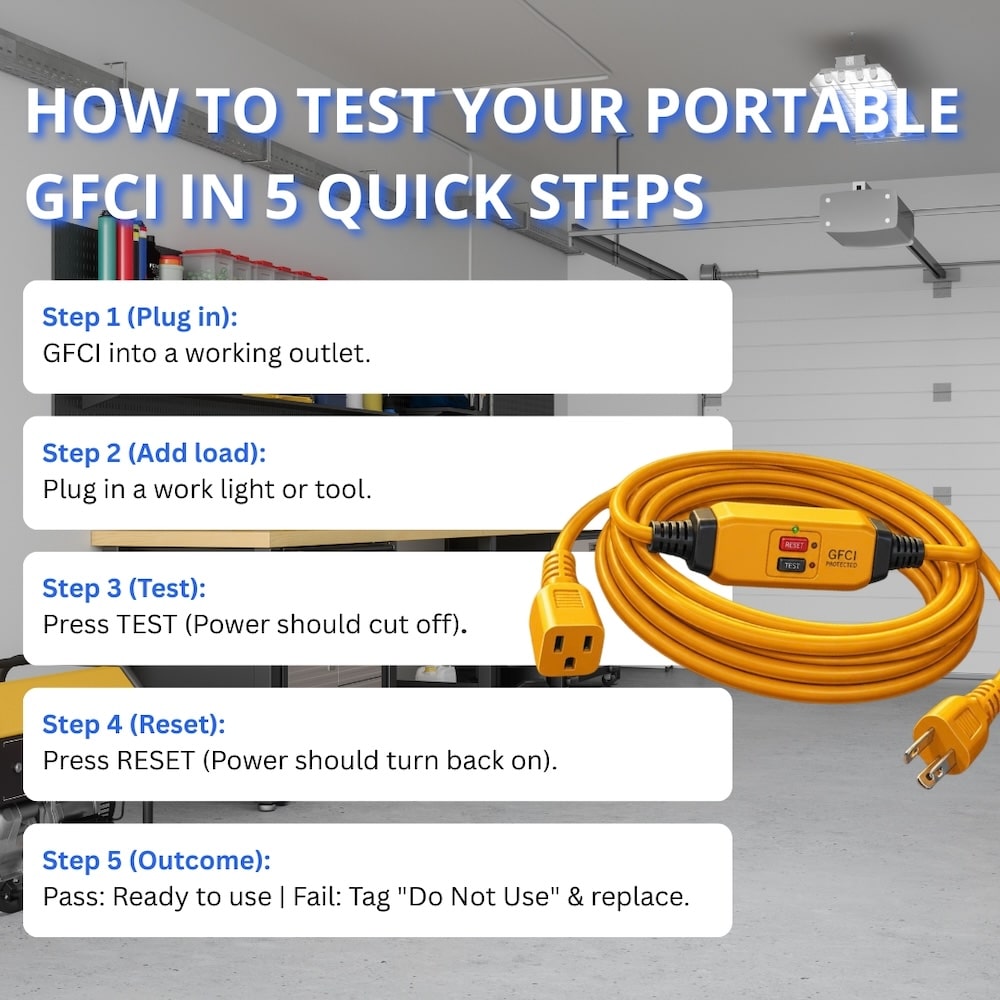
How to Test a Portable GFCI in 5 Steps
Testing a portable GFCI takes less than a minute. Follow these steps before each use:
- Plug the GFCI into a working outlet. If it has an indicator light, check that it shows power.
- Plug in a load. Use a work light, lamp, or small tool so you can see when the power cuts off.
- Press the TEST button. The light or tool should shut off right away. You may hear a click, and the indicator light may change.
- Press the RESET button. Power should come back on. If it doesn’t, the unit has failed.
- Take a failed unit out of service. Don’t use a GFCI that won’t trip or won’t reset. Tag it “Do Not Use” and replace it.
Some portable GFCIs have a “no-voltage release” feature. These units turn off when power is lost and need a manual reset. That is normal, and it’s a safety feature.
A note on plug-in testers: those three-light outlet testers with a GFCI button can be handy, but OSHA has noted that they may not always give accurate results.
The GFCI’s own TEST button with a load attached is the better check.
Do Self-Testing GFCIs Still Need a Manual Test?
Yes. Self-testing GFCIs still need a manual test once a month. Since June 29, 2015, the UL 943 safety standard has required permanently installed GFCIs to have auto-monitoring, which checks the device on its own.
Leviton, a major GFCI maker, says its self-test models check themselves every 15 minutes but should still be tested by hand every month.
Auto-monitoring can’t check every moving part, such as the contacts that open when the GFCI trips. Pressing TEST is the only way to know the whole device works.
Keep in mind that many portable and cord-type GFCIs don’t have self-testing at all. For those, your test before each use is the only check.
What to Do When a GFCI Fails the Test
A GFCI that fails the test must be removed from service and replaced. Here’s what failure looks like:
- It won’t trip. You press TEST, and the tool or light stays on. This is the most dangerous kind of failure, since the GFCI won’t protect you.
- It won’t reset. The power stays off after you press RESET. The device may be worn out, or there may be a ground fault further down the line.
- It trips over and over. A GFCI that keeps tripping might be doing its job. Water in an outdoor cord, a damaged tool, or a worn extension cord can all cause a real ground fault. Unplug everything, then add items back one at a time to find the cause.
- The indicator light flashes red. On many newer GFCIs, a flashing or solid red light means the device has reached the end of its life.
GFCIs protect against ground faults, not overloads. If your problem is a breaker that shuts off when you run too many things at once, that is a different issue.
For more on how GFCIs fit into home wiring, read our post on whether GFCI outlets are required in finished basements.
Where Homeowners Should Use Portable GFCIs
Portable GFCIs aren’t just for construction crews. Any time you run power somewhere wet, outdoors, or temporary at home, a portable GFCI adds protection. Good places to use one include:
- Outdoor power tools and yard work. Hedge trimmers, pressure washers, and electric mowers used on damp grass.
- Portable generators. During a storm outage, use the generator’s GFCI outlets or a GFCI cord.
- Holiday lights and inflatables. Outdoor displays sit in rain and snow for weeks. See our tips on safely setting up Christmas inflatables.
- Basements and crawl spaces. Damp areas where you run work lights or shop vacs.
- Older homes. Many older Pennsylvania homes were built before GFCIs were common. A portable GFCI is a good stopgap until an electrician adds permanent protection.
Water and electricity can also meet near sump pumps, where a tripped GFCI can leave the pump without power. Learn the warning signs of a sump pump that isn’t working.
Related Questions to Explore
How often should you test a GFCI outlet at home?
Test permanent GFCI outlets and breakers at home at least once a month. The U.S. Consumer Product Safety Commission (CPSC) and GFCI makers both recommend a monthly test. Press TEST, check that the power is off, then press RESET.
Does OSHA require GFCI testing before each use?
OSHA’s rule requires GFCI protection on construction sites, but the rule text doesn’t set a GFCI test schedule. OSHA points to manufacturer instructions, which say to test monthly. Most safety training teaches testing portable GFCIs before each use as best practice.
Can I use a plug-in GFCI tester instead of the TEST button?
You can use one as an extra check, but don’t rely on it alone. OSHA has noted that plug-in testers may not always give accurate results. The built-in TEST button with a load attached is the better test.
Why won’t my GFCI outlet reset?
A GFCI may not reset if there’s no power reaching it, if a ground fault is still present, or if the device has failed. Unplug everything from the outlet and try again. If it still won’t reset, have an electrician check it.
What is the difference between a GFCI outlet and a GFCI breaker?
A GFCI outlet protects that outlet and any outlets wired after it. A GFCI breaker sits in your electrical panel and protects the whole circuit. Both need a monthly test using their TEST buttons.
How long do GFCI outlets last?
GFCI outlets often last around 10 years, but damp locations, power surges, and heavy use can wear them out sooner. A GFCI that fails its monthly test should be replaced no matter its age.
When to Call a Professional
Call a licensed electrician if a permanent GFCI outlet won’t trip, won’t reset, keeps tripping with nothing plugged in, or feels warm. Call one as well if your home has outdoor, kitchen, bathroom, garage, or basement outlets with no GFCI protection at all. These are wiring problems, and they aren’t safe DIY fixes.
If you’re buying or selling a home, a professional inspection can catch GFCI problems before they become safety issues.
During a home inspection, our inspectors look at the home’s electrical system and test the GFCI devices they find, following ASHI Standards of Practice.
We note missing protection, failed devices, and other issues in plain language so you know what to fix.
Enviroquest serves Harrisburg, Lancaster, York, and communities within about an hour of our Harrisburg office.
Keep Your GFCIs Working
GFCIs only protect you if they work, and the TEST button is the only way to know for sure.
- Test portable and temporary GFCIs before each use.
- Test permanent GFCI outlets and breakers at home once a month, even self-testing models.
- Replace any GFCI that won’t trip or won’t reset.
Want a clear picture of your home’s electrical safety? Contact Enviroquest to schedule a home inspection, or call us.